Shaping the Future of Cancer Medicine Together
For ten years, the Robert Bosch Center for Tumor Diseases (RBCT) has brought together cutting-edge research, clinical care, and innovation. In this joint interview, Mark Dominik Alscher, CEO of the Bosch Health Campus, and Bernhard Straub, CEO of the Robert Bosch Stiftung, discuss key milestones, prevention, artificial intelligence, and how patient-centered cancer care can become even more effective.
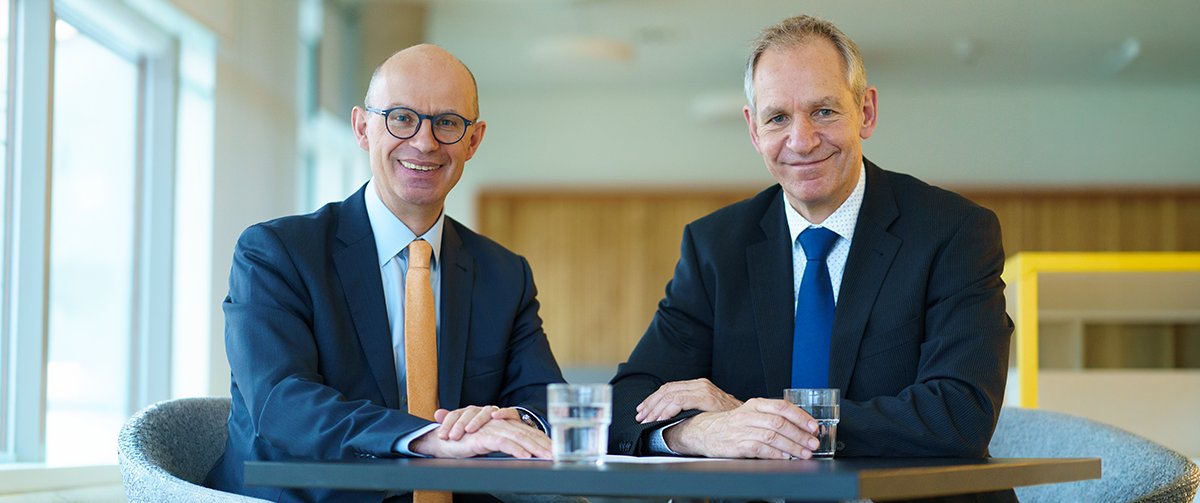
Bernhard Straub (left) and Mark Dominik Alscher (right) discuss the future of cancer medicine and the role of the Robert Bosch Center for Tumor Diseases.
Mr. Alscher, the Robert Bosch Center for Tumor Diseases (RBCT) is known for its close integration of research, clinical care, and innovation. What tangible benefits does this bring to patients at Robert Bosch Hospital today?
Mark Dominik Alscher: Patients benefit from this close integration in many ways. New diagnostic methods enable increasingly precise tumor characterization, creating the foundation for highly individualized therapies. At the same time, clinical trials provide access to innovative treatment approaches—often before they become widely available.
Another key advantage is the close collaboration among different disciplines. Oncology, surgery, radiology, pathology, nursing, and many other professional groups work together to develop the best possible treatment plan for each individual patient. As a result, research is not conducted separately from day-to-day clinical practice but is consistently guided by patients’ needs.
Mr. Straub, the Robert Bosch Stiftung has supported the RBCT from the very beginning. What role does the institute play in advancing the Foundation’s mission?
Bernhard Straub: Health was particularly important to our founder, Robert Bosch, and it remains a guiding principle of our work today. The RBCT is a tangible example of how we continue this legacy in a modern way. Since 2016, we have invested around 65 million euros in building the center and supporting cancer research. Compared with large public research funding programs, our resources are limited, which makes it all the more important how we use them. As a private foundation, we aim to provide targeted momentum: supporting promising ideas at an early stage and translating them into practical benefits for patients as quickly as possible. Knowing that the work being done here in Stuttgart is giving many patients and their families new hope is what drives us.
Which milestones have been particularly significant in shaping the RBCT’s development?
Alscher: Over the years, we have continuously expanded our expertise in cancer research and treatment. Our goal has always been to closely connect research and patient care and to rapidly translate new insights into clinical practice. The establishment of the Department of Molecular Oncology in 2018 and the appointment of Hans-Georg Kopp as Medical Director were among the first major milestones in building the RBCT. At the same time, through our collaboration with the Human Genetics Department at the University Hospital of Tübingen as part of the Comprehensive Cancer Center (CCC) Tübingen-Stuttgart, we brought state-of-the-art diagnostics to patient care at Robert Bosch Hospital.
“Our goal has always been to closely connect research and patient care and to rapidly translate new insights into clinical practice.”
Soon afterward, the pharmacogenomic analytics expertise of our Institute of Clinical Pharmacology helped ensure that patients had access to the best available molecular pathology diagnostics and targeted therapies – an achievement that remains unmatched in the region to this day.
In 2022, Robert Bosch Hospital became the first hospital in Stuttgart to offer CAR T-cell therapy for the treatment of certain leukemias and lymphomas. Today, we are further advancing this therapy through the “ProCell for Patient” project and are working on automated manufacturing processes to make the treatment faster, more affordable, and more widely accessible.
Straub: In 2022, we also appointed Steven Johnsen as Scientific Director of the RBCT. Since then, he has built an outstanding team and established an exceptional research infrastructure.
In 2023, the Bosch Health Campus became part of the National Center for Tumor Diseases (NCT) SouthWest together with the universities and university hospitals of Tübingen and Ulm. This leading research network, funded by the German Federal Ministry of Research, Technology and Space, enables innovative clinical trials and the development of new cancer therapies.
From analyzing large volumes of data for diagnostics to enabling personalized treatments, what role will artificial intelligence play in oncology and medicine more broadly over the coming years?
Alscher: Artificial intelligence (AI) will fundamentally transform oncology – but not as a replacement for medical decision-making. Rather, it will serve as a powerful tool for physicians. AI can integrate vast amounts of clinical, molecular, and imaging data and identify patterns that are difficult for humans to detect. This can improve diagnostic accuracy, support treatment decisions, and enable more precise predictions of disease progression. At the same time, AI will help streamline administrative processes and reduce the burden on healthcare professionals.
What matters most, however, is that these technologies are used responsibly and transparently and are scientifically validated. At the RBCT and throughout the Bosch Health Campus, our guiding principle is to ensure that innovation always delivers clear benefits for patients. AI should help make treatments more personalized, faster, and even higher in quality.

Artificial intelligence is also changing the way we live and work. What role does the Robert Bosch Stiftung see for itself in helping shape this transformation responsibly?
Straub: For us, one thing is clear: Every technology should ultimately be judged by how much it benefits people. This is also at the heart of our 2026 annual theme – the use of digital technologies, such as AI, in a way that promotes the common good and is grounded in human dignity.
Take nursing care, for example. Care teams are working at their limits, and AI will not solve the workforce shortage. But it can reduce documentation workloads and give nurses more time to spend with their patients. The challenge is that many promising solutions never make it into everyday clinical practice. That is exactly the gap we want to bridge. This year, our “Ideas for Impact” award recognized the Bremen-based initiative ProKIP, which ensures that new AI applications reach the places where they are needed most: directly on hospital wards.
Why is it important from the Robert Bosch Stiftung’s perspective to invest not only in cutting-edge medicine and research but also in prevention and health literacy?
Straub: Because the best medicine is the medicine we never need in the first place. Up to 80 percent of cardiovascular diseases and around 40 percent of all cancers could be prevented through effective prevention measures.
Yet our healthcare system still rewards treatment far more than staying healthy. Preventive care is often framed as a purely personal responsibility, and that is unfair. People who work shifts or struggle with financial insecurity often do not have the capacity to participate in complex prevention programs. That is why we want to support people directly in their everyday lives – without lecturing them.
Alscher: A good example is Sundi, a digital companion that we developed together with Charité and the Karolinska Institute. It offers practical support on topics such as sleep, physical activity, and nutrition, particularly for people aged 55 and older. The platform is easy to understand, accessible, and available regardless of a person’s background or financial situation.
With the establishment of a Patient Advisory Council, the voice of patients now has a permanent place within the Bosch Health Campus. What improvements come from seeing patients as active partners rather than simply recipients of care?
Alscher: Modern medicine can only succeed when it is developed together with patients. They experience illness and treatment from a perspective that healthcare professionals do not have. This leads to solutions that are more closely aligned with real-world needs—whether in communication, clinical trials, or the design of care services. For us, patient-centered care means much more than providing excellent treatment. It means actively involving patients in decision-making and recognizing their experiences as valuable expertise.
Germany’s healthcare system faces a range of necessary reforms, including in nursing care, inpatient and outpatient services, and the use of health data for research. Looking ahead, what gives you the greatest confidence about the future of the Bosch Health Campus?
Straub: The pressure for reform in healthcare is enormous. We need a genuine shift in direction – from rigid silo thinking to flexible, interconnected structures. That is exactly the approach we are already putting into practice at the Bosch Health Campus. Different areas work together under one roof, allowing us to leverage synergies directly.
Alscher: One concrete example is our new AI Health Real-World Laboratory SAINDBOX of the Bosch Digital Innovation Hub. There, we are testing digital language technologies directly in everyday clinical practice to simplify workflows and significantly reduce administrative burdens. At the same time, we are already teaching these skills as part of professional training at the Irmgard Bosch Learning Center. Ultimately, however, all of these efforts serve one purpose: ensuring that patients receive the best possible care.