AI on Its Way to the Clinic
Artificial intelligence has the potential to significantly advance medicine. The challenge is bridging the gap between AI models and their clinical application. Two fellows in the “Applied AI in Healthcare Delivery” fellowship program are working to make this happen: Moritz Fuchs is developing AI-powered early warning systems for intensive care units, while Frank Bastian is working on methods for advanced cancer diagnostics.
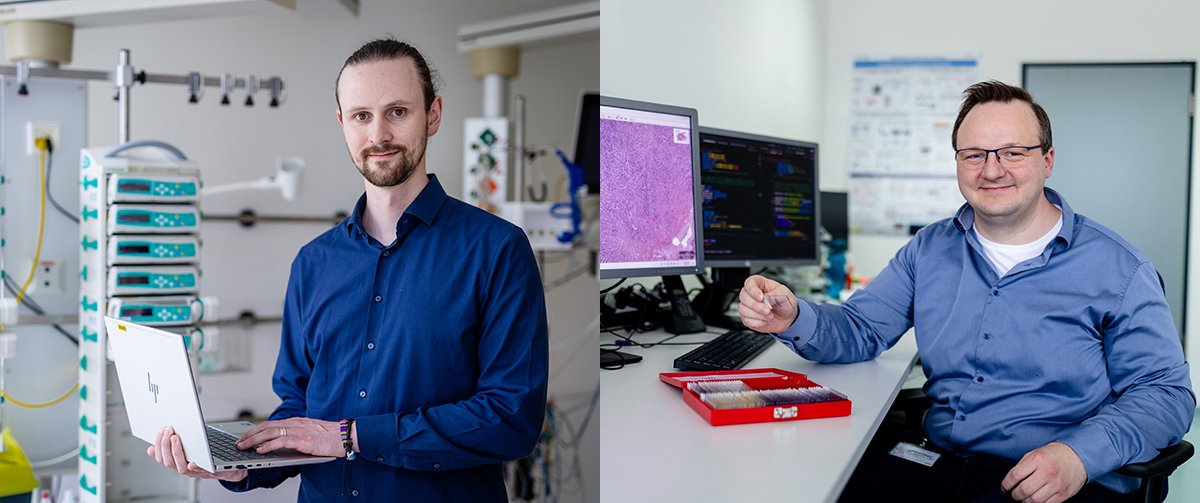
The two fellows, Moritz Fuchs (left) and Frank Bastian (right), are conducting research in their respective fields on AI methods designed to improve medical treatment.
“The best moment is when you feed the AI its first test data and realize: It works,” says Frank Bastian. The computer scientist with a Ph.D. is developing AI methods to analyze breast cancer tissue. The goal is to identify patterns that can help physicians diagnose tumors more precisely and better tailor treatments to individual patients. To date, pathologists typically examine tissue samples under a microscope. Using special stains on cancer tissue, they determine what type of tumor they are dealing with and whether it is benign or malignant. This process requires considerable expertise and time.
This is where Frank Bastian comes in: His AI models are designed to automatically analyze tissue images and make clinically relevant information available more quickly. In the long term, this could lead to affordable predictive tools that can also be applied to other types of cancer.
AI Detects Life-Threatening Conditions
Improving prediction is also at the heart of Moritz Fuchs’s project. “When a patient in the intensive care unit is on the verge of acute kidney failure, there is often only a very short window in which to act. AI can significantly extend that window,” says Moritz Fuchs. As part of the fellowship program, the computer scientist is developing predictive AI models that can detect life-threatening complications at an early stage. The models are based on high-resolution, real-time data from intensive care patients.
Frank Bastian
“The best moment is when you feed the AI its first test data and realize: It works.”
“Bosch Health Campus has already developed AI-based software that can detect kidney failure significantly earlier than before,” says Moritz Fuchs. “My task is to determine how systems like these can be applied to other medical complications or conditions, such as cardiac problems. This could help improve early detection and enable earlier treatment.”
Bridging the Gap Between AI Research and Clinical Practice
Moritz Fuchs and Frank Bastian have been among the early-career researchers in the “Applied AI in Healthcare” fellowship program since 2025. The program was established by Bosch Health Campus in collaboration with ETH Zurich. Its goal is to ensure that AI research does not remain confined to the laboratory, but instead creates tangible benefits for patients.
“AI makes it possible to analyze vast amounts of data and identify patterns that have previously remained hidden. This allows diseases and risks to be examined in increasingly greater detail, opening up new opportunities for prevention, diagnosis, and treatment,” emphasizes Susanne Melin, team leader at the Robert Bosch Center for Innovations in Healthcare, who is responsible for supporting the fellowship program. This is why, she says, it is important to harness the potential of AI for the benefit of patients.
Moritz Fuchs
“In cases of acute kidney failure, AI can significantly extend the window of opportunity for intervention.”
Around €1.5 million is available to support the fellows. In addition to funding their research, the young researchers benefit from workshops, mentoring, and close scientific collaboration between ETH Zurich, Bosch Health Campus, and the Corporate Research division of Robert Bosch GmbH. Regular interaction with medical professionals is also essential to ensure that the AI models being developed are genuinely compatible with workflows in hospitals. “We place particular importance on close networking between the fellows and the supervising scientists at both institutions,” says Melin. No single organization can tackle the current challenges facing healthcare on its own. Strong partnerships and collaboration are essential. “We place particular importance on close networking between the fellows and the supervising scientists at both institutions,” says Melin. No single organization can tackle the current challenges facing healthcare on its own. Strong partnerships and collaboration are essential.
Taking a Holistic Approach to Complex Problems
Niko Beerenwinkel, who heads the “AI in Medicine” field at ETH Zurich and oversees the fellowship program, also emphasizes the importance of the partnership with Bosch Health Campus. Close collaboration is crucial to “overcoming the barriers between fundamental AI research and clinical application,” Beerenwinkel says. The fellows work “interdisciplinarily at the interface between AI method development and clinical translation,” he explains. “Such an environment is essential today because the major challenges in AI can rarely be solved in isolation. Instead, they require a deep understanding of different perspectives. This enables young researchers to learn early on how to approach and implement complex problems from a holistic perspective. At the same time, networks are created that support long-term partnerships and foster innovation.”
Prof. Dr. Oliver G. Opitz
“Our goal is to harness the opportunities offered by AI in medicine, develop innovative approaches, and translate them into healthcare.”
“Our goal is to harness the opportunities offered by AI in medicine, develop innovative approaches, and translate them into healthcare,” explains Oliver Opitz, head of the Bosch Digital Innovation Hub at Bosch Health Campus, which supports the program both strategically and organizationally. “ETH Zurich has internationally recognized expertise in AI research through its AI Center and extensive experience in turning scientific developments into spin-offs,” Opitz says. “At Bosch Health Campus, meanwhile, we focus on successfully translating innovations into real-world healthcare settings.” Together, he adds, the partners are successfully bridging the gap between cutting-edge technological research and clinical application and healthcare delivery.
The Goal: Making an Impact Now, Not Ten Years from Now
The fact that Frank Bastian is now working on AI applications in medicine was not necessarily a given. He initially studied software engineering and computer science in Stuttgart. He went on to earn his PhD in applied mathematics in Ireland, where he developed models to calculate the probability of developing breast cancer while taking a woman’s menstrual cycle into account. “Right after defending my doctoral thesis, I got on a plane to Stuttgart to start working at Bosch Health Campus,” he recalls.
Moritz Fuchs deliberately chose early on to pursue medical AI research with the goal of bringing it into clinical practice. As a computer scientist, he focuses specifically on the interface between technology and immediate clinical benefit. “From the very beginning, I was interested in how we can develop methods that are truly reliable at the patient’s bedside—not ten years from now, but now,” he says.