Ideas for Impact

On behalf of the Robert Bosch Stiftung, the Bosch Health Campus awards the "Ideas for Impact" prize for innovative healthcare models in Germany. The award recognizes concepts that have a lasting impact on the healthcare system and improve the quality of life of older people in particular.

On behalf of the Robert Bosch Stiftung, the Bosch Health Campus awards the "Ideas for Impact" prize for innovative healthcare models in Germany. The award recognizes concepts that have a lasting impact on the healthcare system and improve the quality of life of older people in particular.

EPWUF-AI – Reducing the Burden on Nursing Care in Wound Management: The Example of Diabetic Foot Syndrome Through a Hybrid AI System

There are currently around 9.5 million people living with diabetes mellitus in Germany, with diabetic foot syndrome (DFS) representing a serious complication of the disease. Given the complexity of treating chronic wounds, particularly diabetic foot ulcers, there is considerable potential for digital solutions to improve workflows, reduce the workload of nursing staff, and optimize treatment outcomes.

The EPWUF-AI research project addresses this potential by developing an innovative eHealth solution aimed at improving the quality of care for people with DFS while reducing the workload of nursing professionals. The project focuses on the development of a hybrid system that integrates sensor-based offloading devices, a smartwatch application, a web interface, and a mobile application for digital wound documentation and AI-supported wound measurement. A key component is an AI-based decision-support system that assists nursing staff in clinical decision-making throughout the treatment process.

Consortium Lead: University of Applied Sciences Hochschule Niederrhein, Krefeld

Consortium Partners:

  • CID GmbH, Cologne
  • PI Probaligence GmbH, Munich
  • AKZ Home Nursing Care, Cologne

The project is funded by the Federal Ministry for Research, Technology and Space (BMFTR).

Special Award 2026

ProKIP: Process Development and Support for the Use of AI in Nursing Care

Artificial intelligence (AI) methods are increasingly being used to support nursing care, reduce the workload of nursing professionals, and improve the quality of care. However, the integration of AI into nursing care faces a number of challenges, including significant variations in the level of digitalization across care facilities, limited availability of representative and high-quality data outside hospital settings, a lack of operationalized nursing processes and explicit nursing knowledge, as well as the often formal rather than active involvement of nursing practice and nursing science. Given the high workload in everyday nursing care, it is often difficult to engage care facilities and nursing professionals in AI projects and to collaborate successfully with them throughout the project lifecycle.

The ProKIP project addressed these challenges. Led by the University of Bremen, ProKIP advised and connected research projects on the use of AI in nursing care across Germany. In doing so, it created both a knowledge base on nursing care and AI and a nationwide network for AI in nursing care that also enables peer support.

As part of the project, the publicly accessible AI Nursing Readiness Assessment (KIP-RA) was developed. This tool provides guidance and support for AI projects in nursing care, covering everything from resource planning and project monitoring to evaluation and cross-project comparison. The KIP-RA addresses topics such as the benefits of AI systems in nursing care, the representativeness of data used, approaches to data sharing, the design of participatory processes, and the ethical and professional implications of AI deployment in nursing practice.

The KIP-RA supports stakeholders from both research and nursing practice in the planning, implementation, and evaluation of their projects. By making collective experience from a wide range of AI projects in nursing care accessible, ProKIP highlights transferable good practices and promotes the successful integration of AI solutions into nursing practice.

Consortium Lead:
University of Bremen

Consortium Partners:

  • Charité – Universitätsmedizin Berlin
  • Berliner Hochschule für Technik
  • Verband für Digitalisierung in der Sozialwirtschaft e.V., Halle (Saale)
  • Alexander von Humboldt Institute for Internet and Society (HIIG), Berlin

The project is funded by the Federal Ministry for Research, Technology and Space (BMFTR).

Background information on the jury

The jury is made up of experts from the fields of health research, geriatrics, ethics and futurology.The following section provides detailed information about our jury members:

V.l.n.r.: Laurence Chaperon | Universitätsmedizin Göttingen | M42 | Michael Fuchs | Rolf Schulten-Ärztezeitung | Julia Knop

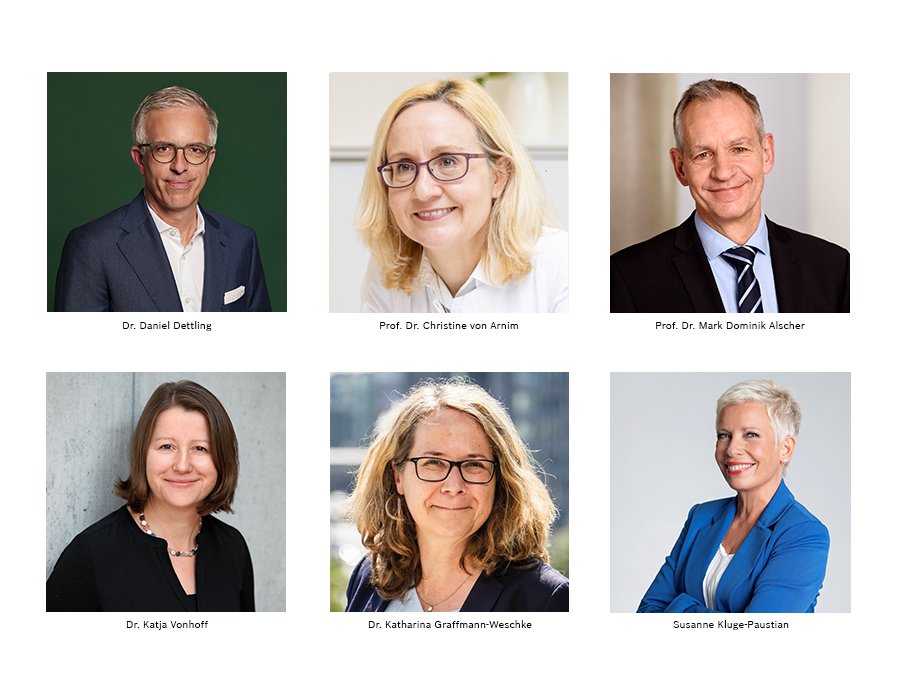
Dr. Daniel Dettling is the founder of the think tank Institut für Zukunftspolitik and heads the Berlin office of the Zukunftsinstitut. Following his civilian service in Israel, the lawyer and political scientist studied law, public administration, political science, and political economy at the universities of Freiburg, Fribourg (Switzerland), Berlin (Second State Examination), and Potsdam (doctorate). He is editor of the edition Zukunftspolitik, co-founder of the German Association of Political Consultants (degepol), and is considered one of Germany’s leading political experts. He has published extensively on issues relating to democracy, demographics, digitalization, social and economic policy, civil society, and political communication, among others, in publications such as Neue Zürcher Zeitung, Süddeutsche Zeitung, WELT, and Welt am Sonntag. For many years, Daniel Dettling has also been a sought-after keynote speaker for companies, NGOs, ministries, associations, political parties, and foundations.

Daniel Dettling is a frequent guest and commentator on television (WELT, N24, ntv, ProSiebenSat.1) and on radio stations (Deutschlandfunk, Deutschlandradio, Inforadio, Radio Eins, WDR).

Professor Christine von Arnim, MD, is Director of the Department of Geriatrics at University Medical Center Göttingen, with a particular focus on cardio-neuro-geriatrics.

Following her medical studies and doctoral degree in Freiburg im Breisgau, she completed her specialist training in Heidelberg/Mannheim and Ulm. She subsequently conducted research at Harvard Medical School (Massachusetts General Hospital) under Bradley T. Hyman, focusing on the mechanisms of Alzheimer’s disease. From 2007 to 2012, she was a fellow of the WIN College (Junior Academy for Young Scientists) of the Heidelberg Academy of Sciences and Humanities. From 2005 to 2019, she was affiliated with the University of Ulm, where she completed her habilitation in Alzheimer’s disease research in 2006 and was appointed Adjunct Professor in 2009. In 2019, she accepted a professorship in Göttingen.

Within her area of expertise, Professor von Arnim focuses on the prevention and treatment of dementia through so-called lifestyle factors such as nutrition, physical activity, and cognitive engagement. She is an expert in the clinical diagnosis and biomarker-based assessment of dementia and leads clinical studies on the prevention and treatment of cognitive impairment and delirium, as well as on the optimization of patient preparation for cardiac interventions.

Her laboratory investigates the pathophysiology of cognitive disorders and ageing in the context of cardiovascular and neurological diseases, combining research on human biomaterials with experimental models.

Prof. Dr. Mark Dominik Alscher is Chief Executive Officer of the Bosch Health Campus and Medical Managing Director of the hospitals of the Robert Bosch Hospital (RBK), the Robert Bosch Medical Research (RBMF), and the Ambulatory Health Care Center at the Robert Bosch Hospital. He also holds a teaching appointment at the Faculty of Medicine of the University of Tübingen.

Prof. Alscher has more than 30 years of experience in the healthcare sector. Among other roles, he serves as Chairman of the Board of Digitale Gesundheit Baden-Württemberg e.V. and as spokesperson for the Health Industry Location Baden-Württemberg initiative.

He studied medicine in Freiburg and, following the completion of his doctoral degree in 1990, undertook specialist training in internal medicine, including rotations in gastroenterology, cardiology, hematology, and nephrology.

Dr. Katja Vonhoff specializes in innovation processes in the social and healthcare sectors. Since November 2024, she has been Director of the Robert Bosch Center for Innovative Health at the Bosch Health Campus. Prior to this role, she established and led the Innovation and Sustainability division at Diakonisches Werk Baden. As an independent consultant, she also supported social and healthcare organizations in the development, financing, implementation, and long-term integration of innovative projects. In her doctoral research in political science at the University of Tübingen, she focused on interorganizational networks, including in the fields of social innovation and technology and innovation transfer. Following an interdisciplinary course of study in Frankfurt am Main and Cardiff (UK), she began her professional career in the foundation sector, working for the Hertie Foundation and the Robert Bosch Stiftung.

Dr. Katharina Graffmann-Weschke studied medicine after completing her nursing training and, following ten years of clinical practice as a physician, earned a degree in Public Health from the Freie Universität Berlin. In 2007, she served as a seconded policy officer at the Federal Ministry of Health in the division responsible for Fundamental Issues of Prevention, Personal Responsibility, Self-Help, and Environmental Health Protection, where she contributed to the development of the National Action Plan for Prevention. From 2007 to 2016, she was Head of Prevention at AOK Nordost and subsequently Director of the divisions for Care Support Centers and Care Counseling. In 2016, she founded the AOK Care Academy, focusing on the qualification and continuing education of care advisors as well as training programs for family caregivers. In the context of the COVID-19 pandemic, she contributed to care-related topics within the Public Health Competence Network on COVID-19. As Coordinator for Safe Care, she established the Non-violent care network for Berlin at the State Office of Criminal Investigation between 2022 and 2024 and provided investigative support. Since July 2024, she has been a member of the Executive Board of the newly established Independent Patient Advice Service for Germany Foundation (UPD).

Susanne Kluge-Paustian is an experienced medical and science journalist as well as a TV and event moderator. She also works as an author, media business coach, and trainer.

From 2017 to 2020, she was a presenter in the business news division of ARD’s Tagesschau24. Since 2009, she has been presenting medical topics for the health magazine Visite on NDR Television, where she has also worked as a reporter and voice-over artist since 2005. Other stages of her career include NDR formats such as Operation Leben, MutMachMenschen, Markt, and DAS!, as well as DW (Deutsche Welle TV), ProSieben, SAT.1, and R.SH.

Alongside her media career, she has been active as a media business coach and trainer since 2010 and is also a dance teacher. In April 2024, her book Dance Like Nobody Is Watching was published by Kneipp Verlag Vienna. She completed her journalistic training and television traineeship at SAT.1 in 1991. Her academic background includes studies in German and Romance languages and literature at Kiel University (Christian-Albrechts-Universität zu Kiel) from 1988 to 1989. Prior to that, she qualified as a medical-technical radiology assistant at University Hospital Schleswig-Holstein.

For her work, she received the Herta Seebaß Media Award from the German Rheumatism League in 2010 and the Journalism Award of the German Society for Angiology in 2020.