We shape innovation, build bridges, and facilitate transformation
In order to address the major challenges facing the German healthcare system in a more targeted manner, the Robert Bosch Center for Innovative Health at the Bosch Health Campus has further developed its strategy. The head of the unit, Dr. Katja Vonhoff, explains which initiatives are designed to help combat the shortage of skilled workers, the digitalization backlog, and low health literacy – and how she measures their success.

“Ultimately, our activities should have a tangible impact on people's lives.”
Dr. Vonhoff, you and your team have realigned the strategy of the Robert Bosch Center for Innovative Health (RBIH). What are the most important goals you want to achieve by 2030?
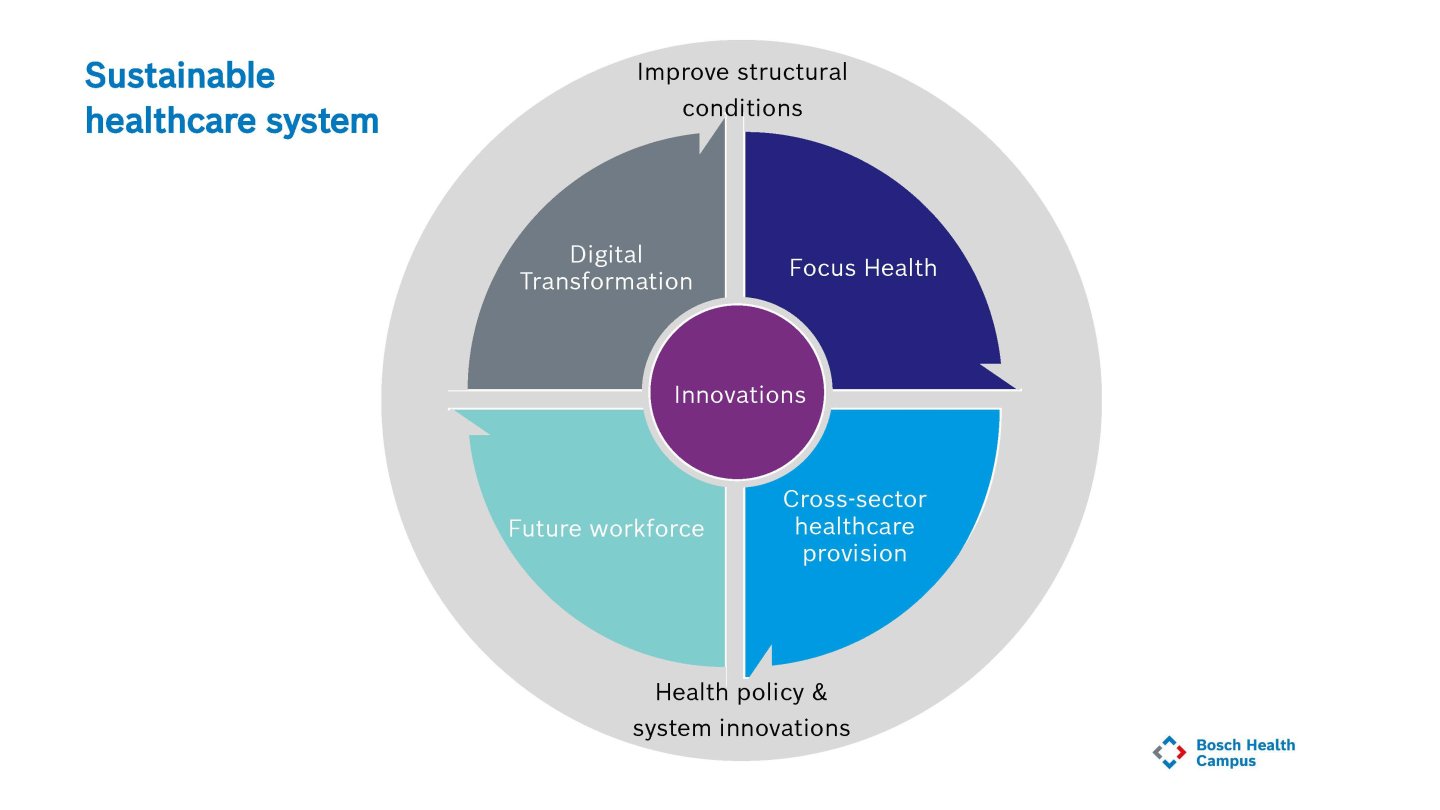
We want to help shape a sustainable, people-centered, and resilient healthcare system in Germany that is innovative and serves the well-being of all. To this end, we have formulated five strategic ambitions:
Focus on health: Our goal is to strengthen people's health and promote health literacy among the population through strategic measures.
Cross-sector healthcare provision: We support the redesign of healthcare to make it cross-sectoral and multi-professional. The focus is on strong primary care as well as prevention and health promotion.
Future workforce: Good healthcare requires skilled workers and managers who are prepared for current and future care needs. We support skilled workers with strategic initiatives to expand their digital skills and make interprofessional collaboration effective.
Digital transformation: Digital transformation is a driver of innovation in healthcare and a guarantee of its future viability. We contribute to ensuring that digital innovations and processes are reliably integrated into healthcare.
Health policy and system innovations: Political and structural conditions in Germany must be improved so that evidence-based innovations can be systematically integrated into standard care and their transfer and scaling can be accelerated. We support and accompany this process with our health policy work.
The Robert Bosch Center for Innovative Health sees itself as having various functions: to shape innovation, to build bridges, and to facilitate transformation. Can you give examples of how these different roles come into play in your work?
Fundamentally, our work follows the social mission of our founder, Robert Bosch. As innovation designers, we create spaces for learning and experimentation and initiate model projects at the Bosch Health Campus and in strategic partnerships. A good example of this is our program PORT – Patient-Oriented Centers for Primary and Long-Term Care – which was developed with experts and inspiration from abroad. We support twelve PORT centers throughout Germany – the most recent one was opened this year right here at the Bosch Health Campus. As bridge builders, we facilitate exchange between the centers and with other partners. And we are working to enable the full integration of the PORT centers into standard care. In this sense, we are transformation facilitators.
Many hospitals, nursing homes, and medical practices are struggling with a shortage of skilled workers. What ideas do you have for attracting more people to healthcare professions—and keeping them there?
We urgently need approaches that relieve the burden on people in their everyday work – digital transformation in particular offers great opportunities here. Skilled workers therefore need to be strengthened in their digital skills. Together with the Irmgard Bosch Learning Center, also part of the Bosch Health Campus, we have launched an initiative that provides nursing staff with the necessary know-how during their training.
Working conditions and corporate and leadership culture are also of paramount importance. In a dynamic and increasingly complex environment, leadership is a key lever for change. Transformational leadership skills enable managers to motivate employees and involve them in change processes by creating meaning, providing individual support, and sharing a common vision. They promote innovation, strengthen team loyalty, and improve the quality of care. Our network “Sciana – The Health Leaders Network,” which we founded together with the Swiss Careum Foundation and the British Health Foundation, addresses this issue: It brings together healthcare leaders from different countries and sectors to develop innovative solutions.
As you said, digital transformation is crucial for progress in many areas of healthcare. What is important now?
Unfortunately, there is still a huge gap between the possibilities offered by digital innovations and the digital infrastructure in healthcare. This means that digital innovations—such as AI for evaluating doctors' letters, robotics to support care, or wearables such as smartwatches for monitoring health data—cannot be developed in isolation. At the same time, work needs to be done on various aspects, including digital infrastructure and organizational development, as well as the development of digital skills among all those involved.
In 2025, the RBIH, in collaboration with Bielefeld University, published a study on health literacy that shows that there are serious deficits in the German state of Baden-Württemberg when it comes to dealing with health information. What conclusions do you draw from this for your work?
The health literacy of people in Germany is generally not particularly well developed. It is particularly poor among people with low levels of education and poor socioeconomic conditions, those with chronic illnesses, and older people. Although there is a wealth of health information available on the internet, many people find it difficult to assess its quality. This is where our non-profit digital prevention service www.sundi.eu/explore comes in. Users receive personalized, evidence-based information, can interact with a chatbot, and set their own realistic health goals with the help of AI. This is important because the study also showed that people with strong health literacy are less likely to use health care services and have more healthy years of life.
Another focus of your work is a stronger emphasis on cross-sector care. What are the benefits of this?
A major problem with our healthcare system is that people often experience gaps between outpatient and inpatient care. For example, when a patient is discharged from an inpatient facility, they have to arrange their own outpatient follow-up care. This often leads to inadequate individual care and high system costs. Cross-sector care is therefore extremely important. With our outpatient PORT Health Center at the Bosch Health Campus in Stuttgart, we have created a place where outpatient and inpatient care go hand in hand. It is located directly in the Robert Bosch Hospital, City.
Dr. Katja Vonhoff

Dr. Katja Vonhoff specializes in innovation processes in social services and healthcare. Since November 2024, she has been Head of the Robert Bosch Center for Innovative Health at the Bosch Health Campus. Prior to that, she established the “Innovation and Sustainability” division at Diakonisches Werk Baden. As an independent consultant, she supported social services and healthcare organizations in the development, financing, implementation, and continuation of innovative projects.
In her doctoral thesis in political science at the University of Tübingen, she focused on interorganizational networks, including in the areas of social innovation and technology and innovation transfer. After completing interdisciplinary studies in Frankfurt am Main and Cardiff (UK), she began her professional career in the foundation sector (Hertie Foundation, Robert Bosch Stiftung).
Successful model projects often fail when it comes to transferring them into standard care. What role does the RBIH play in ensuring that this transfer is sustainable?
There are numerous funding programs that support model projects for a limited period of about two to three years. However, after the pilot funding period, the projects often have not yet reached the necessary level of maturity to be transferred to standard care, or there is a lack of refinancing structures. We are committed to improving the framework conditions at the systemic level so that innovative forms of care can be integrated into standard care more quickly. To this end, we bring together systemically relevant actors at the state and federal level in a constructive, trusting exchange. We also commission relevant studies and write practice-oriented policy papers. At the practical level, we provide exchange platforms and support our funding initiatives in gaining visibility.
If we fast forward to 2030 and look back, how would you personally recognize that your strategy has made a difference?
Ultimately, our activities should have a tangible impact on people's lives. So on a personal level, I would say when people tell me that our initiatives have helped them live healthier lives and receive better care.
To evaluate the success of our strategy and its implementation, we are currently developing a comprehensive impact assessment. Our strategy is opportunity-oriented, which means we regularly review our goals and whether new (e.g., political) opportunities are opening up.