
What Matters Is the Evidence, Not the Label
For ten years, the Department of Integrative Medicine at Robert Bosch Hospital has complemented conventional medicine with evidence-based complementary and lifestyle-oriented interventions. In this interview, its Medical Director, Dr. med. Marcela Winkler, explains why patient interest alone is not proof of effectiveness, why Integrative Medicine requires clear scientific standards, and how it can contribute to a sustainable healthcare system.
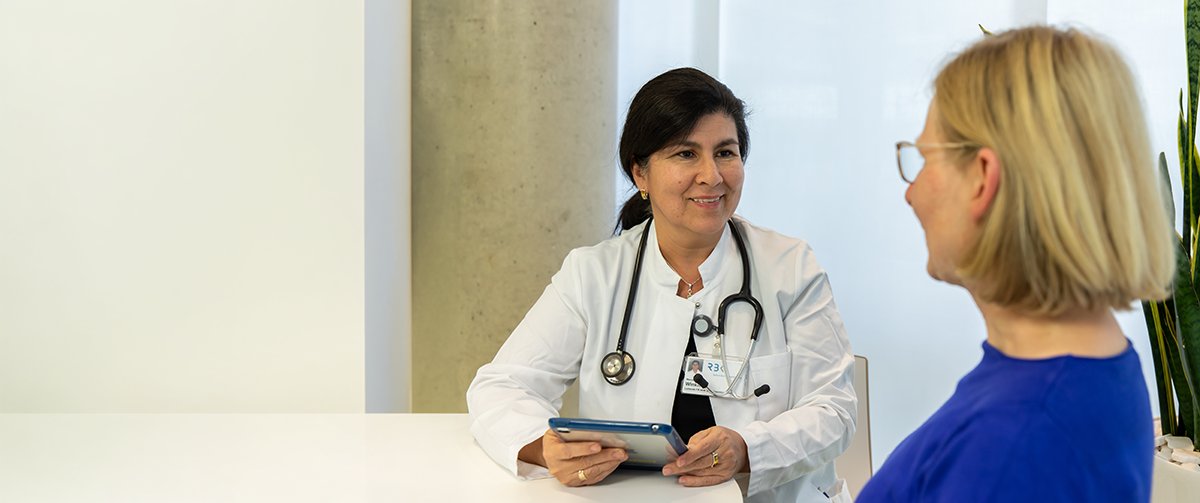
Dr. Marcela Winkler, Medical Director of the Department of Integrative Medicine, speaking with a patient during an initial consultation.
Dr. Winkler, your department is celebrating its tenth anniversary. What has changed during this time?
When the department began its work in 2016, complementary medicine approaches first had to establish their place in everyday clinical practice. Our work was guided by the scientifically grounded “Essen Model” of Integrative Medicine, which had been co-developed by Prof. Gustav Dobos. Today, Integrative Medicine is firmly integrated into both outpatient and inpatient care at Robert Bosch Hospital (RBK). The scientific foundation has also evolved: complementary medicine is now part of guideline-based cancer care, and together with the Robert Bosch Centre for Integrative Medicine and Health, we have established a strong research infrastructure at the Bosch Health Campus. Our treatment portfolio has also expanded well beyond oncology and now serves people with chronic conditions across all medical specialties.
What is your understanding of Integrative Medicine?
At Robert Bosch Hospital, we use complementary therapeutic approaches for which scientific evidence is available. The key considerations are a therapy’s effectiveness and its benefit for patients. Integrative Medicine combines conventional medicine with evidence-based complementary and lifestyle-oriented interventions. It is not an alternative to necessary medical treatment but rather a targeted complement to it. We ask: Which additional interventions are appropriate, effective, and safe for the patient in a specific situation? Examples include acupressure for nausea, exercise and yoga for fatigue, or Mind-Body Medicine approaches such as mindfulness for stress, sleep disturbances, and anxiety
Why is this approach important for patients?
An illness affects not only an organ but also a person’s entire life. People with cancer or chronic diseases often experience pain, fatigue, sleep disturbances, anxiety, and significant changes to their daily routines. Our goal is to alleviate such symptoms and improve quality of life. We support patients in adopting health-promoting lifestyle changes and help strengthen their sense of self-efficacy. We regard health-promoting lifestyle modifications as a foundation of prevention at all levels: they can help prevent disease, slow disease progression, and reduce long-term complications.

Yoga is used not only for preventive purposes but also as a complementary therapy for patients experiencing fatigue.
The representative study published in Frontiers in Medicine in 2024 on the use and acceptance of traditional, complementary, and integrative medicine in Germany showed high levels of support for these therapies. Is public demand already an argument for including them in healthcare delivery?
Demand alone does not demonstrate effectiveness. However, it is a clear mandate for medicine and research. If people are already using complementary therapeutic approaches, they need reliable information and qualified guidance. In the survey, 71 percent of respondents supported increased research. This shows that people are seeking not only access but also scientific guidance. A good healthcare system should neither ignore this demand nor respond to it uncritically.
Where is the evidence already strong enough for these approaches to be used routinely?
In many areas, there is more evidence than people often assume. Complementary therapeutic approaches are now included in numerous clinical practice guidelines, for example for chronic inflammatory bowel diseases, irritable bowel syndrome, and chronic pain. In oncology, the German S3 Guideline on Complementary Medicine provides important guidance. It evaluates interventions from areas such as Mind-Body Medicine, acupuncture, acupressure, and phytotherapy. At RBK, we use scientifically supported methods specifically to alleviate symptoms and treatment-related side effects. These also include nursing applications such as compresses, wraps, and therapeutic rubs. At the same time, responsible counselling requires us to advise against interventions when benefits have not been demonstrated or when risks exist

Integrative nursing care at the bedside: A patient receives an oil application on the ward.
You often speak about self-efficacy. Does this shift responsibility from the healthcare system to patients?
Self-efficacy must never mean holding patients responsible for the course of their illness. In fact, it means the opposite: we want to give them back a sense of agency. Receiving a serious diagnosis is often accompanied by a loss of control. When patients learn how relaxation techniques, physical activity, nutrition, or mindfulness can influence certain symptoms, this can noticeably improve their quality of life. Responsibility for providing high-quality, guideline-based treatment remains, of course, with the professional healthcare system.
How do patient care and research interact at the Bosch Health Campus?
Research questions often arise directly from conversations with patients: What helps with persistent fatigue? Can a non-pharmacological intervention reduce side effects? Such questions can feed directly into research. Under the scientific leadership of Prof. Dr. Holger Cramer, the Robert Bosch Center for Integrative Medicine and Health (RBIM) investigates the effectiveness, safety, and cost-effectiveness of complementary medicine interventions. I serve as Medical Director of both the Center and the department at RBK. This allows research findings to be translated efficiently into counselling and clinical care. Our research is interdisciplinary and conducted in collaboration with universities throughout Germany.
One example is the FOREST study. It investigates whether exposure to nature – whether in a forest, through virtual experiences, or through guided imagery – can reduce fatigue, stress, and other symptoms following cancer. Since 2025, Cochrane Complementary Medicine Germany, based at the Bosch Health Campus and Tübingen University Hospital, has further strengthened the systematic evaluation of research evidence.

Forests may have benefits even virtually. The FOREST study examines whether forest bathing and virtual forest experiences can help reduce cancer-related fatigue.
What is the health policy relevance of Integrative Medicine?
Our healthcare system must address increasing numbers of chronic diseases, an ageing population, and limited human and financial resources. Approaches that promote prevention, health literacy, lifestyle change, and active self-management of illness can make an important contribution. However, this is only true if they are evaluated according to scientific criteria, applied within quality-assured frameworks, and coordinated with the rest of the patient’s treatment.
The World Health Organization’s strategy through 2034 also emphasizes evidence, safety, regulation, and the responsible integration of effective interventions. From a policy perspective, we therefore do not need a blanket decision either for or against complementary medicine. We need high-quality research, clear quality standards, qualified professionals, and sustainable pathways for bringing approaches with demonstrated benefits into healthcare.
Where would you like the department to be in another ten years?
I hope that evidence-based Integrative Medicine will no longer be viewed as something exceptional but rather as a routine component of patient-centred care. Patients should have access to qualified counselling regardless of where they live. At the same time, we must remain willing to continuously evaluate our practice: What works? What does not work? Where do we need better studies? For me, this openness in both directions is a prerequisite for medical progress.