Clone of Clone of We shape innovation, build bridges, and facilitate transformation
In order to address the major challenges facing the German healthcare system in a more targeted manner, the Robert Bosch Center for Innovative Health at the Bosch Health Campus has further developed its strategy. The head of the unit, Dr. Katja Vonhoff, explains which initiatives are designed to help combat the shortage of skilled workers, the digitalization backlog, and low health literacy – and how she measures their success.
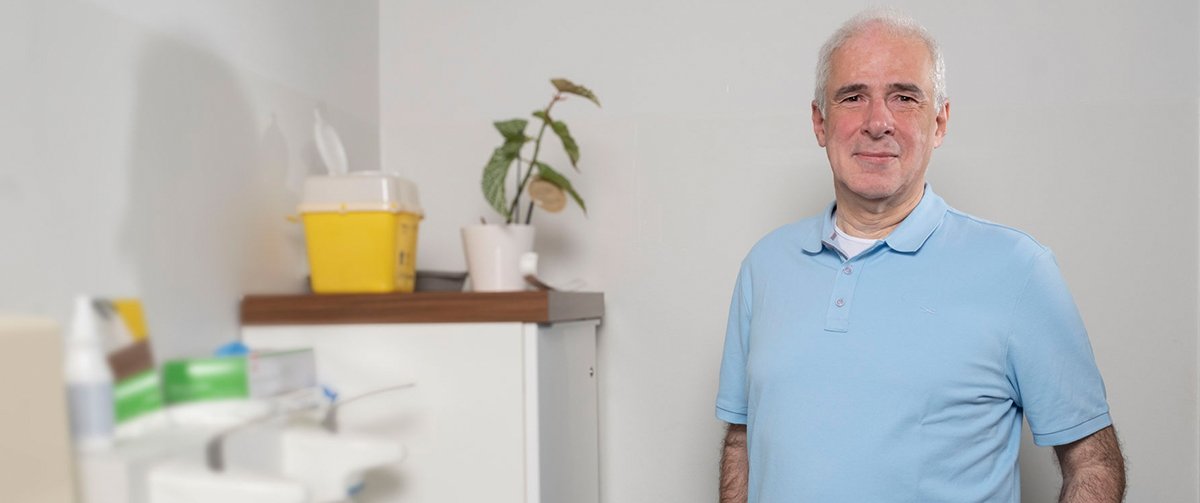
"Seitdem ich als Diabetologe arbeite, kämpfe ich für eine bessere Versorgung dieser Menschen."
Dr. Vonhoff, you and your team have realigned the strategy of the Robert Bosch Center for Innovative Health (RBIH). What are the most important goals you want to achieve by 2030?
We want to help shape a sustainable, people-centered, and resilient healthcare system in Germany that is innovative and serves the well-being of all. To this end, we have formulated five strategic ambitions:
Focus on health: Our goal is to strengthen people's health and promote health literacy among the population through strategic measures.
Cross-sector healthcare provision: We support the redesign of healthcare to make it cross-sectoral and multi-professional. The focus is on strong primary care as well as prevention and health promotion.
Future workforce: Good healthcare requires skilled workers and managers who are prepared for current and future care needs. We support skilled workers with strategic initiatives to expand their digital skills and make interprofessional collaboration effective.
Digital transformation: Digital transformation is a driver of innovation in healthcare and a guarantee of its future viability. We contribute to ensuring that digital innovations and processes are reliably integrated into healthcare.
Health policy and system innovations: Political and structural conditions in Germany must be improved so that evidence-based innovations can be systematically integrated into standard care and their transfer and scaling can be accelerated. We support and accompany this process with our health policy work.
The Robert Bosch Center for Innovative Health sees itself as having various functions: to shape innovation, to build bridges, and to facilitate transformation. Can you give examples of how these different roles come into play in your work?
Fundamentally, our work follows the social mission of our founder, Robert Bosch. As innovation designers, we create spaces for learning and experimentation and initiate model projects at the Bosch Health Campus and in strategic partnerships. A good example of this is our program PORT – Patient-Oriented Centers for Primary and Long-Term Care – which was developed with experts and inspiration from abroad. We support twelve PORT centers throughout Germany – the most recent one was opened this year right here at the Bosch Health Campus. As bridge builders, we facilitate exchange between the centers and with other partners. And we are working to enable the full integration of the PORT centers into standard care. In this sense, we are transformation facilitators.
Many hospitals, nursing homes, and medical practices are struggling with a shortage of skilled workers. What ideas do you have for attracting more people to healthcare professions—and keeping them there?
We urgently need approaches that relieve the burden on people in their everyday work – digital transformation in particular offers great opportunities here. Skilled workers therefore need to be strengthened in their digital skills. Together with the Irmgard Bosch Learning Center, also part of the Bosch Health Campus, we have launched an initiative that provides nursing staff with the necessary know-how during their training.
Was machen die Patientinnen und Patienten dann zum Beispiel anders?
Dr. Dirk Hochlenert: Eine Patientin hat mir erzählt, dass sie auf dem Weg zur U-Bahn beim Treppensteigen einen Alarm ausgelöst hat. Sie hat sich dann am Geländer festgehalten und ist die Stufen seitlich hinaufgestiegen. Oder jemand fuhr Fahrrad, statt zu laufen.
Wieso macht das einen Unterschied?
Dr. Dirk Hochlenert: Das klingt vielleicht banal. Aber das Problem ist doch, dass Menschen mit diabetischem Fuß das Laufen verboten wird, damit sie ihr Bein nicht verlieren. Sie dürfen nur noch vom Bad ins Bett gehen. Über die Hälfte stirbt dann innerhalb von fünf Jahren nach der Diagnose. Denn, wenn man sich nicht mehr bewegt, kommen die Herz-Kreislaufkrankheiten. Wer einen diabetischen Fuß hat - und das sind mehr als hunderttausend Betroffene jedes Jahr, hat eine schlechtere Überlebenswahrscheinlichkeit als die meisten Krebspatienten. Mit der Sohle können sie wieder laufen. Das hebt die Lebenserwartung und die Lebensqualität, die Betroffenen bleiben selbständig und nehmen am Leben Teil.
Weshalb ist die Versorgung der Patienten mit diabetischem Fuß so schlecht und wie kann sich die Situation mit ihrer Erfindung verbessern?
Dr. Dirk Hochlenert: Die Krankheit hat nicht das Prestige. Deshalb freue ich mich so über den Gesundheitspreis „Ideas for Impact“. Denn an sich ist es leicht, die Versorgung der Betroffenen zu verbessern. Wir haben dafür unsere Sohle mit einer KI-basierten Entscheidungshilfe für das Pflegepersonal verknüpft. Eine Software erledigt nun die Dokumentation: Fieber, das Ausmaß an Schmerzen, Grunderkrankungen und das Protokoll der Alarme - alles was Einfluss auf die Wunde hat wird darin zusammengeführt. Die Wunde wird fotografiert und automatisch vermessen, indem der Wundrand erfasst wird. Auf der Grundlage dieser Parameter erstellt die KI eine Wundprognose: Geht es aufwärts oder sollte man die Behandlung überdenken? Dabei hilft sie, der Mensch behält aber immer das letzte Wort.
Sie haben in Ihrem Forschungsprojekt überprüft, ob das Pflegepersonal das Werkzeug annimmt und entlastet wird. Wie waren die Ergebnisse?
Dr. Dirk Hochlenert: Pflegekräfte haben mit neuer Technik oft schlechte Erfahrung gemacht. Wenn sie nicht gut funktioniert, ist das aufgrund des hohen Zeitdrucks kaum auszuhalten. Ich hatte mit dem Schlimmsten gerechnet, weil es doch oft Anlaufschwierigkeiten gibt. Aber unsere Pflegekräfte waren durchweg angetan und haben in den meisten Fällen die vorgeschlagene Therapieempfehlung übernommen. Die Dokumentation über das System war sehr schnell und hat zu Zeitersparnis geführt.
Wie geht es nun mit der Innovation weiter?
Dr. Dirk Hochlenert: Es ist so eine segensreiche und einfache Sache, dass es für mich jetzt grausam ist, wenn mir das im klinischen Alltag nicht zur Verfügung steht. Es muss ein Medizinprodukt werden. Die Regularien dafür sind heftige Hürden, die wir ohne Partner, z.B. aus der Industrie, nicht überwinden können.
Kann die technische Lösung das Pflegepersonal auch in anderen Bereichen unterstützen?
Dr. Dirk Hochlenert: Ja, es gibt auch das Wundliegen, den Dekubitus, bei bettlägerigen Patienten. Auch da ist der Druck als physikalische Messgröße das entscheidende Kriterium. Hier wäre es also genauso vorstellbar, dass ein ähnliches intelligentes System das Pflegepersonal unterstützt. Dann haben wir das offene Bein, schlecht heilende Wunden, auch dort kann ein Druckmesssystem gepaart mit KI den Pflegekräften Kopfzerbrechen und Arbeit abnehmen.