Ideas for Impact

On behalf of the Robert Bosch Stiftung, the Bosch Health Campus awards the "Ideas for Impact" prize for innovative healthcare models in Germany. The award recognizes concepts that have a lasting impact on the healthcare system and improve the quality of life of older people in particular.

On behalf of the Robert Bosch Stiftung, the Bosch Health Campus awards the "Ideas for Impact" prize for innovative healthcare models in Germany. The award recognizes concepts that have a lasting impact on the healthcare system and improve the quality of life of older people in particular.

Stay@Home – Treat@Home

Well Connected at Home, Medically Cared For

The number of people receiving outpatient care is steadily increasing. Currently, the majority of people in need of care in Germany are cared for at home. When acute treatment is required, this often leads to emergency admission or hospitalization. In many cases, this could be avoided if changes in the health of people in need of care were detected and communicated at an early stage, and if a medical or nursing assessment and treatment could be initiated directly where necessary. This is precisely where the award-winning project Stay@Home – Treat@Home, led by Charité – Universitätsmedizin Berlin, comes in. People in need of care can be monitored and receive medical care at home. With a closely coordinated care network comprising outpatient and inpatient services, supported by state-of-the-art technologies and telemedicine, the project aims to reduce hospital stays and thus relieve the burden on the healthcare system. The foundation is communication between general practitioners and their patients, with the option of extending this to other medical specialties or institutions involved in care in acute cases.

Consortium Lead: Charité – Universitätsmedizin Berlin

Consortium Partners:

  • bildbau gmbh
  • GWQ ServicePlus AG
  • Hausarztpraxis Dr. med. Irmgard Landgraf
  • Institute for Health Care Systems Management e. G.
  • Johanniter-Unfall-Hilfe e. V.
  • Kassenärztliche Vereinigung Berlin
  • Malteser Hilfsdienst gGmbH
  • Techniker Krankenkasse
  • Zentralinstitut für die kassenärztliche Versorgung

The project is funded by the Federal Joint Committee – Innovation Committee.

Background information on the jury

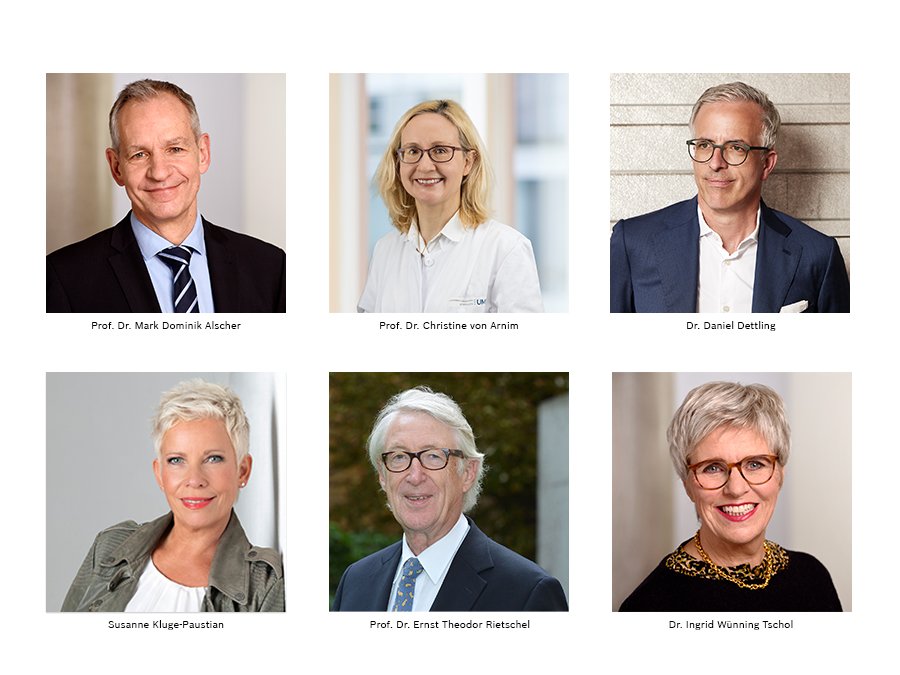
The jury is made up of experts from the fields of health research, geriatrics, ethics and futurology.The following section provides detailed information about our jury members:

IFI_Collage_Jurymitglieder
(v.l.n.r.) FotostudioM42, umg/fskimmel, Laurence Chaperon, Julia Knop, BIH/David Ausserhofer, Christoph Schmid
 

Prof. Dr. Mark Dominik Alscher is Chief Executive Officer of the Bosch Health Campus and Medical Managing Director of the hospitals of the Robert Bosch Hospital (RBK), the Robert Bosch Medical Research (RBMF), and the Ambulatory Health Care Center at the Robert Bosch Hospital. He also holds a teaching appointment at the Faculty of Medicine of the University of Tübingen.

Prof. Alscher has more than 30 years of experience in the healthcare sector. Among other roles, he serves as Chairman of the Board of Digitale Gesundheit Baden-Württemberg e.V. and as spokesperson for the Health Industry Location Baden-Württemberg initiative.

He studied medicine in Freiburg and, following the completion of his doctoral degree in 1990, undertook specialist training in internal medicine, including rotations in gastroenterology, cardiology, hematology, and nephrology.

Professor Christine von Arnim, MD, is Director of the Department of Geriatrics at University Medical Center Göttingen, with a particular focus on cardio-neuro-geriatrics.

Following her medical studies and doctoral degree in Freiburg im Breisgau, she completed her specialist training in Heidelberg/Mannheim and Ulm. She subsequently conducted research at Harvard Medical School (Massachusetts General Hospital) under Bradley T. Hyman, focusing on the mechanisms of Alzheimer’s disease. From 2007 to 2012, she was a fellow of the WIN College (Junior Academy for Young Scientists) of the Heidelberg Academy of Sciences and Humanities. From 2005 to 2019, she was affiliated with the University of Ulm, where she completed her habilitation in Alzheimer’s disease research in 2006 and was appointed Adjunct Professor in 2009. In 2019, she accepted a professorship in Göttingen.

Within her area of expertise, Professor von Arnim focuses on the prevention and treatment of dementia through so-called lifestyle factors such as nutrition, physical activity, and cognitive engagement. She is an expert in the clinical diagnosis and biomarker-based assessment of dementia and leads clinical studies on the prevention and treatment of cognitive impairment and delirium, as well as on the optimization of patient preparation for cardiac interventions.

Her laboratory investigates the pathophysiology of cognitive disorders and ageing in the context of cardiovascular and neurological diseases, combining research on human biomaterials with experimental models.

Dr. Daniel Dettling is the founder of the think tank Institut für Zukunftspolitik and heads the Berlin office of the Zukunftsinstitut. Following his civilian service in Israel, the lawyer and political scientist studied law, public administration, political science, and political economy at the universities of Freiburg, Fribourg (Switzerland), Berlin (Second State Examination), and Potsdam (doctorate). He is editor of the edition Zukunftspolitik, co-founder of the German Association of Political Consultants (degepol), and is considered one of Germany’s leading political experts. He has published extensively on issues relating to democracy, demographics, digitalization, social and economic policy, civil society, and political communication, among others, in publications such as Neue Zürcher Zeitung, Süddeutsche Zeitung, WELT, and Welt am Sonntag. For many years, Daniel Dettling has also been a sought-after keynote speaker for companies, NGOs, ministries, associations, political parties, and foundations.

Daniel Dettling is a frequent guest and commentator on television (WELT, N24, ntv, ProSiebenSat.1) and on radio stations (Deutschlandfunk, Deutschlandradio, Inforadio, Radio Eins, WDR).

Susanne Kluge-Paustian is an experienced medical and science journalist as well as a TV and event moderator. She also works as an author, media business coach, and trainer.

From 2017 to 2020, she was a presenter in the business news division of ARD’s Tagesschau24. Since 2009, she has been presenting medical topics for the health magazine Visite on NDR Television, where she has also worked as a reporter and voice-over artist since 2005. Other stages of her career include NDR formats such as Operation Leben, MutMachMenschen, Markt, and DAS!, as well as DW (Deutsche Welle TV), ProSieben, SAT.1, and R.SH.

Alongside her media career, she has been active as a media business coach and trainer since 2010 and is also a dance teacher. In April 2024, her book Dance Like Nobody Is Watching was published by Kneipp Verlag Vienna. She completed her journalistic training and television traineeship at SAT.1 in 1991. Her academic background includes studies in German and Romance languages and literature at Kiel University (Christian-Albrechts-Universität zu Kiel) from 1988 to 1989. Prior to that, she qualified as a medical-technical radiology assistant at University Hospital Schleswig-Holstein.

For her work, she received the Herta Seebaß Media Award from the German Rheumatism League in 2010 and the Journalism Award of the German Society for Angiology in 2020.

Prof. Dr. rer. nat. Dr. med. h.c. mult. Ernst Theodor Rietschel, born on 21 May 1941, studied chemistry at the Universities of Munich and Freiburg. After earning his doctorate at the Max Planck Institute for Immunobiology in Freiburg in 1973 and completing his habilitation in biochemistry at the University of Freiburg in 1978, he was appointed Full Professor (C4) of Immunochemistry at the University of Lübeck in 1980 and simultaneously became Director at the Leibniz Center for Medicine and Biosciences in Borstel. His scientific work focused on the immunobiology and structural chemistry of bacterial endotoxins as well as on sepsis research.

Between 2005 and 2010, Ernst Rietschel served as President of the Leibniz Association. In 2006, he was Acting Chair of the European Medical Research Councils, and from 2007 to 2008 he served as Scientific Director of the Medical Faculties of the Universities of Kiel and Lübeck in Schleswig-Holstein. Since 2010, he has held the position of Presidential Representative for EU Affairs at acatech – the National Academy of Science and Engineering. From 2013 to 2015, he served as Chairman of the Executive Board of the newly established Berlin Institute of Health (BIH).

Ernst Th. Rietschel has received numerous distinctions, including the Major Award of the German Society for Hygiene and Microbiology (1996) and the Aronson Prize of the City of Berlin (1999). He was also awarded honorary doctorates by the Universities of Lausanne, Lübeck, and Würzburg. In addition, he received the Grand Cross of the Order of Merit of the Federal Republic of Germany, the French Ordre national du Mérite, and Japan’s Order of the Rising Sun, Gold Rays with Ribbon.

Dr. Ingrid Wünning Tschol is Senior Vice President Strategic Science Advice at the Robert Bosch Stiftung and former Director of the Robert Bosch Center for Innovation in Healthcare. She earned her doctorate in biology from the University of Tübingen in 1985. From 1985 to 1990, she conducted postdoctoral research at the Massachusetts Institute of Technology (MIT) in Cambridge and at the State University of New York at Stony Brook, USA. Further stages of her career included positions at the German Research Foundation (DFG) in Bonn and the European Science Foundation (ESF) in Strasbourg. She also served as Vice Chair of the European Research Area Board (ERAB). More recent committee and board activities include membership of the ETH Zurich Foundation, the University Council of Ulm University, the Board of Trustees of the African Agricultural Technology Foundation (AATF), the CAREUM Foundation Zurich, and the Scientific Advisory Board of the Zukunftskolleg at the University of Konstanz.