
"Like a New Life"
Severe obesity is associated with significant physical and psychological burdens. Addressing it requires knowledge, sensitivity, and perseverance. The Obesity Trialogue at the PORT Gesundheitszentrum brings together patients, family members, and healthcare professionals, creating a space for open and respectful exchange among equals.
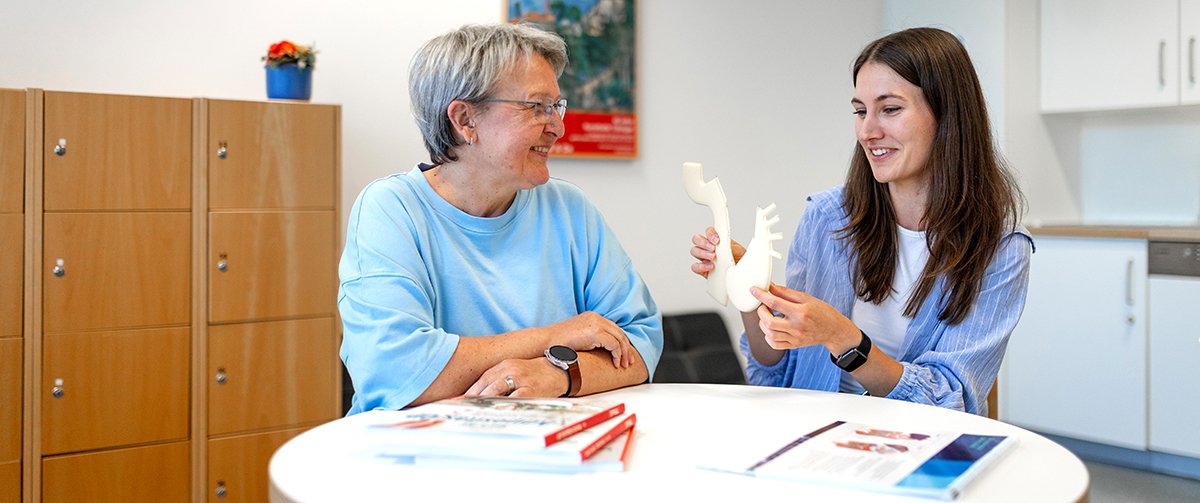
Nutritional scientist Jasmin Ketel explains the consequences of gastric bypass surgery to a patient.
“I never would have imagined it, but it feels like a life 2.0,” says Kerstin Schäfer. Since her stomach surgery in January 2026, she has lost 25 kilograms and feels “as if you’re starting to live again.” In 2012, she developed depression and had to take medication. While the treatment helped, it also came with side effects, and Kerstin Schäfer steadily gained weight. Physical activity became increasingly difficult, and everyday tasks grew more exhausting. When the number on the scale eventually reached three digits, she decided something had to change. “At some point, it simply became too much.”
A Space Free of Judgment
While searching for support, Kerstin Schäfer first came to Robert Bosch Hospital for nutritional therapy. There, she learned about the Obesity Trialogue, a regular forum where patients, their relatives, and healthcare professionals engage in open discussions.
The trialogue format originally emerged in the field of eating disorders, explains Jasmin Ketel, a nutrition scientist who supports obesity patients at Robert Bosch Hospital. “Many people affected by obesity cannot find a suitable place where they can easily and informally learn about treatment and counseling options,” says Ketel. “That is why we wanted to create a program where not only patients and family members can ask questions, but where healthcare professionals can also gain a better understanding of patients’ concerns and needs.”

Professionals from various departments participate in the trialogues. In the past, experts from nutritional counseling, bariatric surgery, and the sleep laboratory have attended, along with external specialists. The meetings are organized and held at the PORT Gesundheitszentrum. For Mike Teske, Director of the Center and moderator of the sessions, creating an atmosphere of trust and openness is particularly important. “Everyone addresses each other informally, speaks from a personal perspective, and whatever is shared stays in the room. The exchange demonstrates how valuable it can be for everyone involved when different perspectives come together.”
Many participants especially appreciate the combination of personal experience and professional expertise. Kerstin Schäfer agrees: “What makes it special is that there isn’t a ‘demigod in a white coat’ sitting there. Instead, people talk to each other as equals.”
When Excess Weight Becomes a Disease
The need for action in cases of severe obesity should not be underestimated. It significantly increases the risk of type 2 diabetes, cardiovascular disease, stroke, and sleep apnea, and it can also affect fertility and family planning. The psychological burden is often considerable as well. Today, approximately one in four adults in Germany is affected by obesity.
“What makes it special is that there isn’t a ‘demigod in a white coat’ sitting there. Instead, people talk to each other as equals.”
“Many people do not realize that obesity is a chronic disease. It has only been officially recognized as such in Germany for the past six years,” explains Dr. Yorick Soeder, a specialist in visceral surgery with a focus on bariatric surgery at Robert Bosch Hospital. “Unfortunately, the disease is still heavily stigmatized.” The causes are often complex, he says. Medication, lack of physical activity, psychological factors, the constant availability of food, and social conditions may all contribute. At the same time, there is a shortage of easily accessible support services in many places. “Most general practitioners simply do not have the capacity to provide comprehensive long-term support,” says Soeder. This is precisely why information services and open dialogue are so important — to educate people and overcome stereotypes.
The Long Road to Surgery
Rita Huber is also familiar with prejudice related to her weight. Over nearly five decades, the 68-year-old tried numerous diets, repeatedly lost weight, and then regained it. “The issue has really accompanied me throughout my entire life,” she says. She also experienced health complications, including severe acid reflux, a hiatal hernia, and an increased risk of esophageal cancer. “My doctor recommended gastric bypass surgery as early as the end of 2024,” Rita Huber recalls. “Then, through recommendations from friends, I came to Robert Bosch Hospital in the fall of 2025.”
There, she became familiar with the bariatric treatment concept. Before bariatric surgery—a surgical intervention for severe obesity-patients generally complete a six-month multimodal therapy program. Nutritional therapy, psychological support, and physical activity programs form the three central pillars of treatment. The goal is not only to reduce weight but also to establish sustainable habits and improve patients’ quality of life over the long term.
What started as treatment for eating disorders now provides people with obesity with guidance and courage to take the next step in their therapy through exchange on an equal footing.
Rita Huber found this approach extremely helpful and appreciated the guidance it provided. The discussions at the trialogue also gave her additional confidence and trust in the upcoming surgery. There, she exchanged experiences with patients who had already undergone surgery, learned from them, and received answers to her questions. In February 2026, she ultimately underwent gastric bypass surgery, which not only reduced the size of her stomach but also shortened the section of the small intestine responsible for nutrient absorption. The changes have made a significant difference for her. “My knee problems and snoring have improved, and so have my blood pressure and breathing,” says Rita Huber with relief. “So far, I’ve lost about 25 kilograms. I’m glad I did it.”
A New Life After Surgery
In Kerstin Schäfer’s case, after the six-month preparation period, the medical team decided on a sleeve gastrectomy, surgically reducing the size of her stomach. As a result, she feels significantly more mobile today. Not only is climbing stairs easier, but she can once again enjoy long walks with her small dog. “Before, that simply wasn’t possible anymore,” she says.
Both women continue to attend the Obesity Trialogue regularly even after their surgeries. “You can help others who are in a similar situation to the one you were once in yourself,” says Rita Huber.